My Flowers Have No Scent
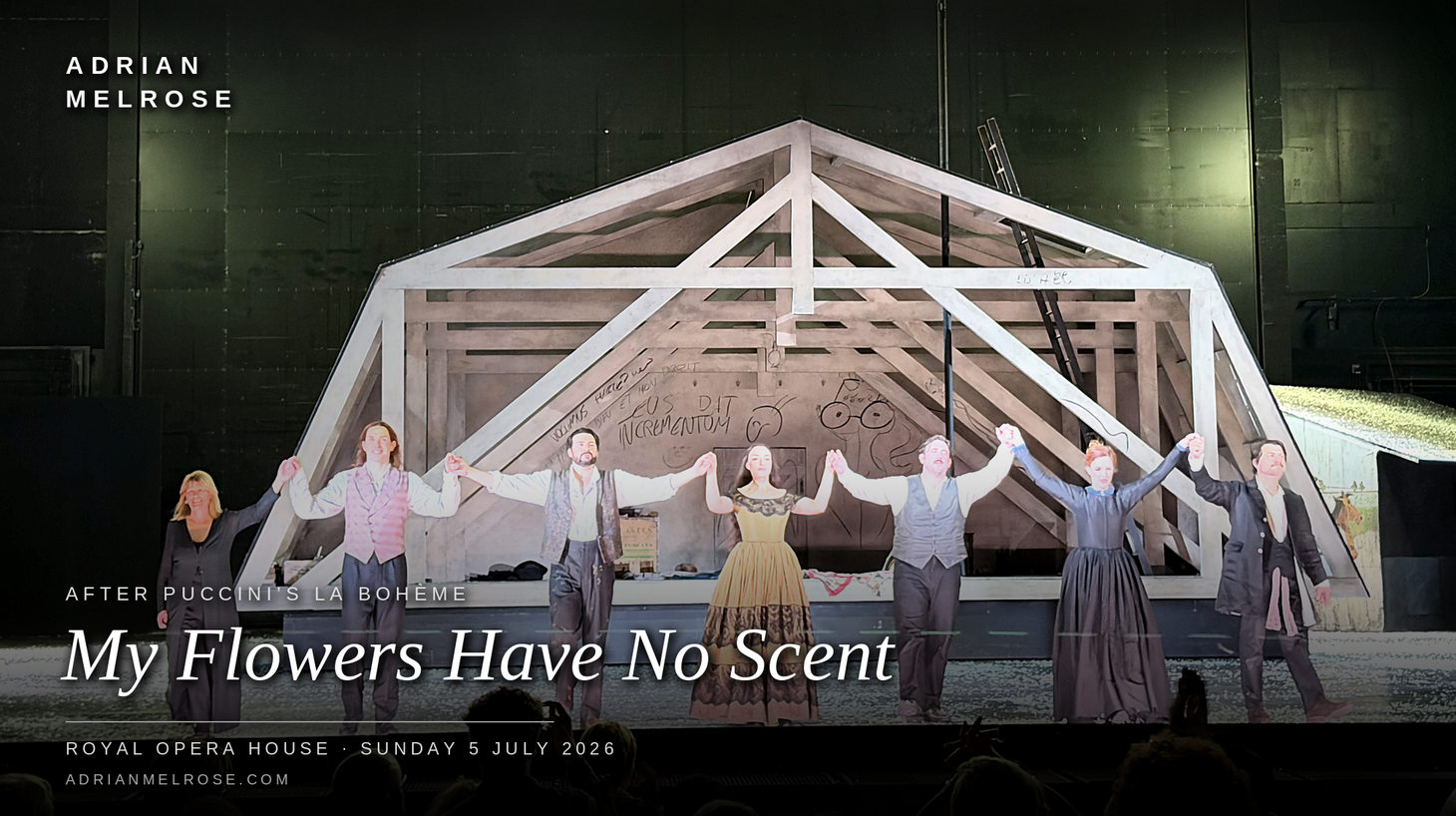
On La Bohème, two dating profiles sung by candlelight, and the man who could tell the truth in the dark but couldn't say it in daylight
I had a theatre weekend of accidental symmetry. Saturday night was Sondheim's Company, which I wrote about in the last piece: a man who spends two and a half hours learning to want closeness. Sunday afternoon, at the Royal Opera House, was Puccini's La Bohème: a man who wants closeness within about four minutes of meeting a stranger, wins it completely, and then loses it for a reason I've spent the last six essays writing about. I didn't plan the pairing. The pairing found me.
Let me deal with the performance first, because it deserves it. This production was as fine as any I've seen, and the cast was impeccable. Juliana Grigoryan's Mimì broke me exactly where the score intends to break you, and Freddie De Tommaso's Rodolfo had the kind of open-throated ardour the part demands. And what gave the afternoon its edge was the acting. I'm aware that praising the acting in an opera can come out sounding like praising a chef for the cleanliness of his plates, so let me be plain about what I mean. Grigoryan and De Tommaso acted as finely as they sang, and Luca Micheletti and Marina Monzó as the storm-system couple Marcello and Musetta were just as alive: real people in real rooms, playing to each other rather than to the house. That's a rare pleasure in this art form, and it's part of why the afternoon followed me home.
But the reason I'm writing isn't the singing. It's what happens in Act One, in the dark, between two strangers. Because I sat there watching a scene written in 1896 and realised I was watching two people exchange dating profiles. And theirs are better than ours.
Two profiles by candlelight
If you don't know the story: Rodolfo is a poet, freezing in a Paris garret with his equally broke friends on Christmas Eve. His friends go out; he stays to finish some writing. There's a knock. A neighbour, a young seamstress, stands at the door. Her candle has gone out on the stairs and she asks for a light. She's ill, she nearly faints, her candle blows out again, she drops her key, and suddenly two strangers are on the floor of a dark room, searching. His hand finds hers. It's freezing. And out of that one touch comes the most famous fifteen minutes in opera.
What follows is, structurally, a matched pair of introductions. He sings Che gelida manina: your tiny hand is frozen. She answers with Mi chiamano Mimì: they call me Mimì. He tells her who he is; she reciprocates; they walk out into the night together. Puccini invented the dating app in 1896, except the room is dark, everyone's poor, and there are no photographs.
The joke holds up. What stopped me in my seat was the content. Because look at what these two actually choose to disclose, and hold it against what any of us would write today.
Rodolfo leads with his lack. Who am I? A poet. What do I do? I write. How do I live? I live. Then, without a beat of hesitation, the poverty: in my cheerful destitution, he tells her, I squander rhymes and love songs like a lord. He is a millionaire in spirit only, and he says so in his opening minute. Think about that. A modern profile is an exercise in curated strength. The job title, the travel photographs, the height. Rodolfo's first move is to hand a beautiful stranger the exact information most men would rather die than volunteer on a first date: I have nothing. Here is the one thing I do have, which is dreams, and I notice that two thieves, a pair of beautiful eyes, have just walked off with all of them.
It works. It works because what she's being offered is a person rather than a package.
Then Mimì answers, and her profile is even better. Her first line is a small confession about the profile itself: they call me Mimì, but my real name is Lucia. Even my handle isn't quite me; here is what's underneath it. Then, no achievements. None. She embroiders flowers, in silk, at home, alone. She lives in a little white room and looks out over the rooftops. She loves the things that speak of spring, and when the thaw comes the first sunshine is hers, the first kiss of April is hers.
And then the line that has followed me since Sunday, the detail a lesser librettist would never have found. The flowers she makes, she says, have no scent.
I can't get over that line. It's an admission of the gap between the life she stitches and the life she wants, offered to a stranger in the first quarter hour, and it tells you more about her inner world than any inventory of hobbies ever could. Nobody writes my flowers have no scent on Hinge. Everybody writes love to travel.
So there's the first thing the opera knows that the app economy has forgotten. These two lead with the very material we've all been trained to bury: his poverty, her loneliness, the unscented flowers, the dreams that don't pay. Vulnerability first, credentials never. And on that foundation, fifteen minutes of it, they build the most convincing falling-in-love in the repertoire.
The dark did what the swipe can't
Then there's how they met, which might matter even more than what they said.
She knocks because her candle has gone out. That's the whole premise: a stranger, at night, needing a small kindness. No vetting. No mutual friends. No gallery of photographs assessed in advance, no exchange of prospects, no checking whether his profile says 6'1". Two people encounter each other under the worst possible conditions, ill and broke and freezing, and the connection happens through voice, proximity, story, and one frozen hand found in the dark.
That's the inversion worth sitting with. The dark forces them to encounter each other before they can assess each other. The apps run the sequence the other way round: assessment first, exhaustively, and encounter only if the assessment clears. We evaluate, then meet. They met, then discovered. And I'd gently suggest the discovery order is the one that produces the thing everyone on the apps says they're looking for.
I'll admit my favourite detail is the least respectable one. When Mimì drops her key, Rodolfo finds it, and pockets it. Says nothing. Keeps searching beside her so the searching can go on. A tiny, cheeky dishonesty entirely in the service of prolonging an encounter. I'm not endorsing it as a technique. I'm noticing what it optimises for: more time with this one person, in this one room. The algorithm optimises for the opposite. Infinite alternatives, and therefore no reason at all to prolong any single candle-lit moment, because the next profile is already loading underneath this one.
The complication I have to be honest about
Now, before this curdles into a grumpy sermon about how things were better in 1896, let me name the obvious problem. La Bohème is no slow-burn romance. These two declare love inside a quarter of an hour. By any modern safeguarding standard, Mimì follows a strange man out into the Paris night with a speed that would alarm her friends. If the lesson here were be patient, take it slow, resist instant gratification, the opera would be a terrible witness for the defence.
So that's the wrong lesson, and I want to draw the right one precisely. The difference between Act One and the Hinge era isn't speed. It's depth. Rodolfo and Mimì go deep fast: real fears, real poverty, real longing, all on the table by midnight. We go shallow endlessly: months of assessment, galleries of options, and somehow never one exchange as honest as my flowers have no scent. The modern failure isn't that we move too quickly. It's that we've replaced encounter with evaluation, and evaluation can run forever without either person ever being met.
Depth over assessment. That's the tool I'd lift from Act One and hand to anyone dating now. The question isn't how long you've known someone. It's whether either of you has yet said one true, uncredentialed, slightly frightening thing.
And then daylight comes
If the opera ended after Act One, this would be a lighter piece, and I nearly wrote that piece. But the story goes on, and where it goes is straight into the territory this series lives in. Because the same man who could tell a stranger the whole truth in a dark room turns out to be unable to say one particular truth in daylight, and it costs him everything.
By Act Three, months on, the love affair is failing and nobody watching can quite see why. Rodolfo has turned jealous, prickly, impossible. He tells his friend Marcello that Mimì is a flirt, that it's over, that she's the problem. And then, in one of the most devastating reversals Puccini ever wrote, the real reason comes out of him, in pieces, while Mimì, unseen, overhears every word. Mimì is dying. Consumption. And Rodolfo, a poor man in a freezing garret, cannot afford to keep her warm, cannot afford a doctor, cannot save her. Love, he says, is not enough on its own. His room is a squalid den and he is watching the woman he loves fade in it, and he cannot bear what that says about him.
Sit with what he did with that truth. He couldn't say I'm frightened, she's dying, and I can't provide what would save her. So he manufactured a grievance instead. He converted helplessness into jealousy, because jealousy at least casts him as a man wronged rather than a man failing. The accusation was easier to speak than the fear.
Readers of this series will recognise the shape of that from a long way off. It's the cape. It's the same silence I kept in my own marriage when the money was running out and the words would not come, because saying I can't do this felt identical to saying I have failed as a man. It's fear in better clothes, the thing I spent a whole essay learning to distinguish from care. And underneath the fear, right on schedule, the older and heavier thing: shame. Rodolfo's silence isn't protecting Mimì. She's dying either way, and she already suspects. His silence is protecting him, from the verdict he's already passed on himself: that a man who cannot provide for the woman he loves has stopped being a man at all. That verdict was installed in him by the same script that was installed in me, and in my father, and in his. Puccini staged it seventy years before Terry Real gave us the language for it, and he staged it accurately: the tenderest man in the opera, undone by the one sentence patriarchy forbids him to say.
And here is the ache of it. This is the man who once led with his lack. I'm a poet, I'm poor, I live on dreams. He could confess poverty to a stranger when the stakes were a flirtation in the dark. He cannot confess helplessness to the woman he loves when the stakes are her life, because now the poverty isn't charming bohemian colour. Now it's the measure of him. The dark made honesty easy. Daylight, and love, and consequence made it impossible. Which tells you the honesty of Act One, beautiful as it was, hadn't yet been tested. It was the profile. Act Three is the marriage.
The two of them do find a gentler ending to that scene, and it's very human: they agree to part, then agree to wait until spring, because nobody wants to be alone in winter. Even their separation is a postponement, a truth agreed and then softened. I understand that move from the inside too.
What the frozen hand was really asking
So this is where the weekend's two shows ended up arguing in my head on the way home along the river. Company shows you a man who can't yet want closeness. La Bohème shows you a man who can want it, magnificently, and win it with fifteen minutes of honesty, and then lose it because wanting and winning were never the hard part. The hard part is what I keep finding at the bottom of every one of these essays: staying honest once there's something to lose. Rodolfo's tragedy isn't poverty and it isn't even the illness. It's that the truth-telling that opened the love could not survive inside it.
For those of us dating, or coupled, in the era of infinite profiles, I think the opera leaves two instructions rather than one. The first is Act One's: lead with the unscented flowers. Say the true, uncredentialed thing early, because that's the only material connection can actually be built from, and no amount of assessment substitutes for it. The second is Act Three's, and it's harder: keep saying it. The disclosure that felt brave by candlelight has to be repeated in daylight, at cost, when it no longer makes you charming and might make you small. That's the version nobody's profile can promise and no algorithm can screen for.
So here's what I'm leaving you with, whichever side of the candle you're currently standing on.
What's your my flowers have no scent: the one true thing about your life as it actually is, rather than as it presents, that you've never yet said early, out loud, to someone you hoped would stay?
Say that one first. The rest is just a profile.

Adrian Melrose Newsletter
Join the newsletter to receive the latest updates in your inbox.