Off the Books
On a business that was really an appeal, a family ledger with one column, and the exhaustion I never once felt
Three days before the phone call, we had breakfast.
He was my non-executive director, and a close friend, and by that point the only other person carrying the business alongside me. We sat across a table from each other, and I remember looking at him and seeing, with complete clarity, how much he was carrying. His tiredness was legible to me. I could have written you a full account of his load, line by line.
I could not have written you a single line about my own.
Three days later his wife called to tell me he'd had a massive heart attack. He didn't make it. It was March 2020, three days before the country locked down and the entire travel sector, our sector, was switched off by governments like a light.
I want to tread carefully here, because the people who loved him knew how much he was carrying, and that knowledge is part of their grief, and none of it is mine to narrate. I make no claims about what the carrying did or didn't do. What I can tell you is only what I saw across that table: two strong men being strong for each other, both of us fluent in each other's exhaustion and illiterate in our own.
That breakfast is the closest thing this essay has to a moment of realisation. Which is the confession I've been circling for six years, and the reason this piece exists.
There was no moment.
The appeal
If you've been with this series a while, you know about the cape. In The Cape Didn't Fit I wrote about an earlier business, the one that struggled while I held the baby, and about the truth I couldn't say to my wife while the money ran out. That essay was about the silence. This one is about what I did next.
Because here's what I did next. I didn't take the cape off. I sewed a bigger one.
The new venture was a travel tech startup. I raised two million pounds from shareholders who trusted me, and a serious share of our own family's money went in alongside theirs. By September 2019 it was on a trajectory that, hand on heart, felt like it could end with an exit to the likes of Amazon. That wasn't a fantasy I told investors. It felt founded and real, and I believed it in my body.
But the business was never just a business. It was an appeal. The first failure had gone into my private courtroom as a verdict, on my worth as a provider, as a husband, as a man, and the startup was the retrial. I had been given a second chance to bounce back, and I needed the bounce to be seen. Every hour worked was evidence for the defence. Every hour rested was evidence for the prosecution.
You can rest from a job. You cannot rest from an appeal.
Then the machine started shedding parts. My co-founder left for Shopify, and I don't blame him, it was a good move by a good man, but it left me flying solo. What remained was a daily arithmetic that never balanced: two software developers, a rural hiring desert in the years before AI made small teams mighty, a sales team shouting for features, clients wanting features, revenue waiting on features, features waiting on people we could not find or afford. My weeks disappeared into investor relations, keeping the faith of the people whose money I was carrying. I was trying to keep everybody happy, all the time: shareholders, clients, employees, the board, my wife.
And that was only the business. At home I carried the primary care of our two teenage daughters, at school in Canterbury while we lived in Suffolk. For the better part of a year, one of them needed to come home every weekend, for reasons that are hers and stay hers. So on Friday nights I drove the six-hour round trip, down the A12 through its permanent archaeology of cones and contraflows, around the M25, over the Dartford crossing, and did the whole thing again on Sunday night. Even the road home was under repair.
There was also the house. We were modernising a 1595 Elizabethan manor, a beautiful, demanding thing that was a full-time job which had never been advertised as one. I lived inside something old and magnificent that consumed everything I could give it.
I just kept going. I kept everyone's futures in the air. I used to describe myself, without hearing what I was saying, as the only solutions provider in the business. The provider. Stated as a job title. Nobody hired me for that role. I'd been reporting for it since I was about six years old.
The family P&L
Somewhere in those years, the marriage acquired a scoreboard.
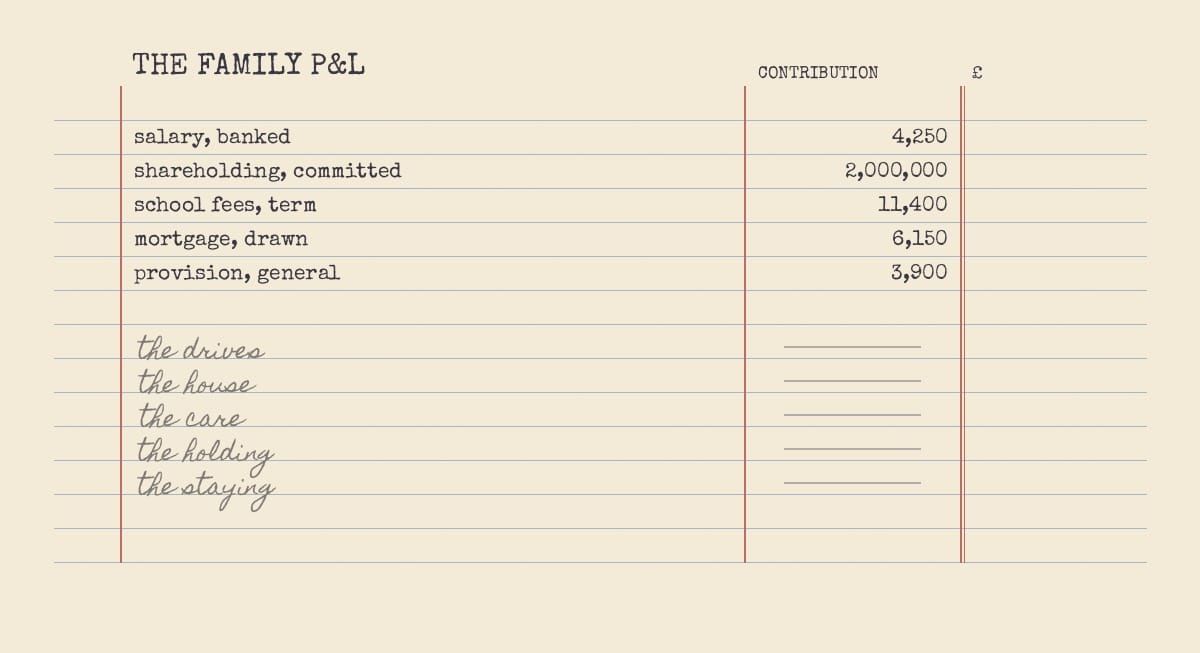
Here is the twist my younger self would not have believed. I am a chartered accountant by training. I spent the first years of my working life learning double-entry bookkeeping, the discipline whose entire genius is that every entry has a counterpart, that nothing real goes unrecorded. And yet the family I lived in ran on single-entry books. One column: financial contribution. On that metric my wife won hands down, and I felt like a man losing badly who didn't know what to do, because the things I was carrying never appeared in the family P&L.
I can't tell you what that scoreboard meant to her, or how she'd describe it. Her side of the ledger isn't mine to narrate. What I can tell you is what I did with it, which is the part that indicts me.
I accepted the game. I never once contested the scoreboard; I tried to win on it. The whole redemption business was an attempt to post a number in the one column that counted, rather than the harder move of saying the ledger itself was wrong. And all the while I kept a second set of books completely hidden. The drives, the house, the care, the holding of everyone's futures: I never submitted a single entry for accounting. I carried it all off-balance-sheet and then felt the injustice of the balance sheet. Two people running a marriage on accounts neither would show the other. Fifty-fifty, and honestly earned.
Why didn't I table my entries? I've sat with that a long time, and the answer is the same one that runs through this whole series. Itemising what I carried would have meant saying I need this to count. That sentence begins with I need, and I need has been forbidden since I was a boy. Same silence as the cape. Same fear, wearing consideration's clothes.
And there's an irony here big enough to hold the whole culture. The single-column ledger is the one men built. Patriarchy measured a man by his provision and made everything else invisible: the care work, the driving, the mental load, the labour that has been women's for generations and counted for nothing. I spent years benefiting from that accounting without ever auditing it. Then the roles in my own house reversed, and I ended up on the wrong side of the very instrument my own sex had calibrated. The scoreboard doesn't have a gender. It has a column. And only one.
The feeling that never arrived
Here is the strangest thing about those years, and it's the finding this essay exists to report. I did not know I was exhausted. Not once. There was no morning I woke and named it. I soldiered on through the co-founder leaving, through the impossible arithmetic, through the breakfast, through the phone call, through a pandemic that closed my industry. The exhaustion never announced itself, because I had never been taught to feel it.
Boys like me were trained out of it early. Fatigue was laziness. Venting was complaining. The gentleman's education I wrote about at the start of this series didn't just forbid the sentence I'm tired. It made sure the feeling underneath the sentence never surfaced at all.
But energy is conserved, even in a man. The exhaustion had to register as something, so it converted into the two feelings I still knew how to have: loneliness and failure. I felt utterly alone, the only solutions provider, with no one to turn to and least of all my wife, because telling her the second business was struggling would have confirmed the original verdict. And I felt like a failure, constantly, corrosively, in a way that dismantled my sense of who I was.
Look at what I was actually facing. Two developers. A hiring desert. A sector switched off by government order. The odds were structural, and no honest observer would have scored that board against the man playing it. But I read the whole thing as personal inadequacy, because inadequacy was a feeling I could feel.
Exhaustion, in a man built this way, doesn't feel like tiredness. It feels like failing.
That is the sentence I'd want any man to take from this essay, because it explains the years better than I can. And it has a cruel corollary, which is where this piece began: what we cannot feel in ourselves, we can see perfectly in the people we love. At that last breakfast I could read every line of my friend's load. In myself, nothing.
The man the moment demands
I found language for all of this in a book I wish had existed in 2019. Jason Wilson's The Man the Moment Demands came out of his decades running the Cave of Adullam in Detroit, where he trains boys and men in what he calls emotional stability. Wilson writes from deep Christian faith, he refers to God as Yah throughout, and I mention that plainly because it's who he is, and the truth of what he sees doesn't depend on whether you share his scripture.
Two of his ideas landed in me like keys turning.
The first: when a man says he's tired, he almost never means he needs sleep. Sleep, in Wilson's telling, is an unconscious state that restores the body. Rest is something else entirely, a conscious state of freedom from whatever is wearying the soul. A man can sleep eight hours a night for a decade and never rest once. I know, because I did. Rest requires the absence of an audience, and my audience had been internalised decades earlier: the boy who learned to be watched became a man who watched himself, so even alone, even asleep, some part of me was still on duty. Terry Real calls this performance-based esteem. When your worth is your function, you cannot clock off, because your worth clocks off with you.
The second idea is the book's spine. Wilson describes what he calls the comprehensive man, and his claim is that a whole man contains many men, the fighter, the provider, the leader, the lover, the nurturer, the gentleman, the friend, and that maturity is sending into each moment the man that moment actually demands. Most of us never got the full set. We were handed one man in boyhood, told he was the whole of us, and we've sent him into every room for the rest of our lives. Mine was the provider. The grieving room got the provider. The frightened room got the provider. The rooms that were asking for the nurturer, the friend, the man who could say I don't know how to hold all this, they got the provider too, standing in the doorway with his solutions.
The wrong man in the moment. Every moment. For years.
And then Wilson says a thing that made me laugh out loud in recognition, because he arrived at it with no knowledge of me or this series: he tells men to take off the superhero cape, because it is strangling them. His image, in his book. I'd written about that exact cape long before I read him. When two men who've never met reach for the same garment to describe the same suffocation, you can stop wondering whether the pattern is personal.
What it cost to stop
The business survived, and that matters to me more than most of what I've listed here. We preserved it for the employees and the clients, and I walked away. Not everyone read it that way. When the pandemic hit, travel was the most exposed sector on earth, and no shareholder was going to keep propping up a travel business through it. The funding stopped, and the plan to convert the debt into equity died with it. Nobody was a villain in that part; it was arithmetic. The harder part was closer in. Some of the people who worked for me seemed to believe my pockets were deep enough to carry the business personally, and that carrying it was somehow my obligation. At the time I felt the unfairness of that expectation keenly. I feel it differently now, because I can finally see who founded it. A man who spends years being the only solutions provider, who absorbs every problem and never once shows a limit, is teaching everyone around him that he has none. I had made their futures my personal responsibility long before anyone asked me to, so when the end came, they only expected of me what I had always expected of myself. I've made my peace with the casting. When provision is the whole measure of a man, the end of provision reads as the whole betrayal. The same single-entry books, one last time, closing me out. And then I did the thing I'd been unable to do in any smaller denomination: I stopped. A reorientation of career, a reboot of life, a deliberate step towards simplicity, towards a life without the hefty weight of performance across its shoulders.
I have to be honest about what that means, because it would be easy to end this with a lesson I didn't actually learn. I did not learn to rest inside that life. I found rest by demolition. I left the theatre; I didn't learn to be offstage while the play ran on. And demolition can't be the prescription, because most of the people reading this can't walk away from the company, the mortgage, the school fees, the whole load-bearing architecture of their obligations. If rest is only available at the price of burning the set, most men will simply never rest, and that can't be the answer.
Nor did the simpler life arrive painlessly. It took six years, and a great deal of discomfort sits in the middle of that sentence. I still catch the provider walking into rooms nobody called him to. But I show up now for the people I love on terms that feel like living, and when I say I'm tired these days, I usually know it before anyone has to bury the evidence.
Only recently, in a men's circle, someone handed me the last piece of this. We were reflecting on the weight of responsibility, which still trips me up more often than I'd like, and one of my peers, a coach himself, pointed at the word's own construction: response-ability. The ability to choose a response. I had carried responsibility my whole life as a weight that arrived from outside, an obligation with my name pre-printed on it. But the word itself says otherwise. What I called responsibility was a response, chosen, over and over: the inherited reflex to make everyone else's life less painful than my own. And the choosing had a driver this series has met before. Under the fear of failing everyone sat the older thing, shame: the certainty that a better man would never have needed help. Fear was about what they would all think. Shame was the verdict I had already returned on myself.
And notice where that reading finally arrived. In a room of men, from a peer who could see my load the way I had once seen my friend's across a breakfast table. Other men can read in us what we cannot read in ourselves. That, more than anything, is why I sit in rooms with them now.
The writing on the wall
There is one more thing about that breakfast, and I've kept it for the end because it took me six years to understand it.
He spent part of that morning talking about a book. Who Moved My Cheese?, Spencer Johnson's small parable about four characters in a maze, and what each of them does when the cheese they've built their lives around runs out. He kept saying he wished more people in his life would read it. He was urging me to. And underneath the recommendation I formed an impression, which I hold as an impression and nothing more: of a man who felt something in his own life needed to change, and who could not see a way to change it that didn't mean, as he seemed to weigh it, letting down the people who depended on him.
I recognise that clause now. It's the one this whole essay has been about. A man changing his life reads, on the single-column books, as a man failing his family. I don't offer that as a fact about him. I offer it as the first time I ever heard the clause spoken almost aloud by someone other than the voice in my own head, and I sat there, fluent in his load, and did not hear my own.
The most famous thing in that little book is a question one of its characters writes on the wall of the maze: "What would you do if you weren't afraid?"
I can't know what routes he was tracing on his own copy. I only know that six years later, when I finally walked out of a station that had run out of cheese, his recommendation was still sitting where he'd left it. I think of that breakfast now as the morning a friend passed me a map across the table. It has taken me until this essay to say thank you.
The audit
So let me leave you inside the language of my first profession, since it turned out to be the right one after all.
Every life runs on a ledger. Almost nobody chooses their columns; we inherit them, the way I inherited a single column marked provision and posted my whole self against it. And whatever your ledger doesn't count, you will still pay for. The care, the driving, the holding, the staying, the weight nobody sees you carry: off the books is where honest entries go to become resentment, and where exhaustion goes to be misfiled as failure.
I was a trained accountant running my own life on books I would have refused to sign off for any client.
So run the audit. Look at the accounts your life is actually kept in, the ones your family runs on, the ones inside you that decide each night whether you succeeded or failed at the day. Look at what gets counted, and look hard at what you're carrying off the books.
Are you scoring the right things?

Adrian Melrose Newsletter
Join the newsletter to receive the latest updates in your inbox.