The One-Way Door
On dating profiles, one honest sentence, and whether holding each other's emotions is something we offer or only something we seek
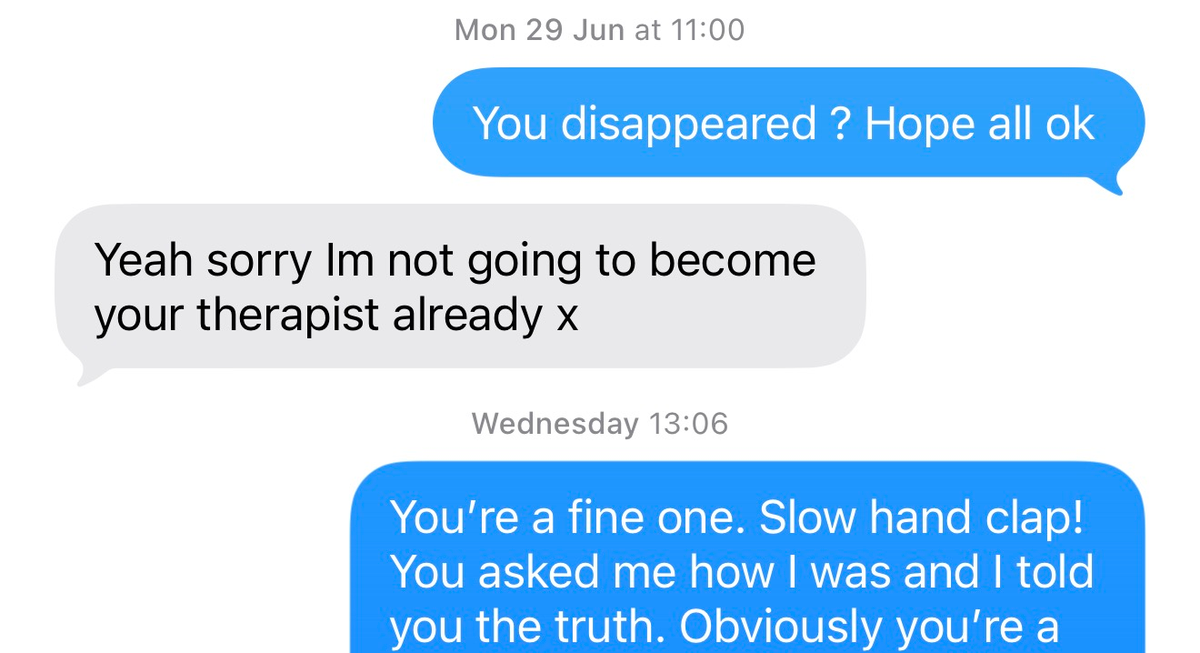
The exchange took four messages to die. I've changed her name and blurred the details, because she isn't the villain of this piece — hold that thought, I'll come back to it — but the shape of what happened is exactly as it happened.
We'd matched, moved off the app, and she opened with the ordinary kindness of a first message: how's your weekend been?
I told her the truth. Not a long truth. One sentence: not the easiest, to be honest — processing it all. Then I turned the conversation toward her, asked about the business she was building, told her I loved that she was building it.
Silence. Two days of it.
When I checked in — you disappeared? hope all ok — the answer came back with a kiss on the end of it, which somehow made it worse: yeah sorry, I'm not going to become your therapist already x.
It took one honest sentence. She asked how my weekend was. I gave her the true answer rather than the polished one, and inside a day the whole thing was dead, with a diagnosis pinned to it. She had read a single line of honesty as an application for a job, decided the job was therapist, and turned it down.
Now here's the detail that turns this from an anecdote into a pattern worth writing about. Her profile — the one I'd read before any of this — asked for a man who was emotionally aware. It said so twice. Once in the about-me, once in the list of what she was seeking. She was, the profile also mentioned, a psychology graduate.
She had the vocabulary. She had the training. She had the stated preference, in writing, in two places. And the first live test of it lasted one sentence.
The spec sheet
Spend any time on the apps and you'll see it everywhere. Emotionally available. Emotionally intelligent. Emotionally aware. It's become standard equipment on the seeking side of women's profiles, the way good sense of humour was twenty years ago. I don't doubt the sincerity of it for a second. I think women mean it. I think they're exhausted by men who can't locate a feeling with both hands, who go silent for days, who make their partners do the emotional labour of two people. The request is real, and it's earned.
But read the rest of the spec sheet, because the same profiles ask for something else in the same breath. Ambitious. Driven. Confident. Has his own thing going on. Doesn't take life too seriously. Building something.
I know that man. I've been that man. That's the cape — the costume I wrote about in an earlier piece, the one I wore through a marriage while the money ran out and the words wouldn't come. The provider, the steady one, the man who carries things and never needs carrying. And here he is, listed as a requirement, two lines below emotionally aware.
Nobody notices the contradiction because it isn't experienced as one. It's experienced as a reasonable list of good qualities. But look at what's actually being requested: a man fluent in feelings who never has any at an inconvenient moment. A man who can hold your feelings and produces none of his own. Emotionally aware, in the way a good hotel is aware of you — anticipating, attending, asking nothing back.
That isn't a partner. That's staff.
Before you sharpen anything on her
I want to stop here and be fair, because the easy version of this essay is a grievance with a byline, and I'm not writing that one.
She's allowed a boundary. She was two messages into knowing me — she owed me nothing, least of all the holding of a stranger's difficult weekend. She may have her own history of men who heard psychology graduate and unpacked their entire childhood by the second date. If she's ever been conscripted as the unpaid therapist in a relationship, then her early-warning system has a reason to exist, even if it fired at the wrong target. Her exit was clumsy. It wasn't a crime.
And more to the point: she didn't write her half of the script any more than I wrote mine. The same system that handed me the cape handed her the expectation of it. Patriarchy runs a double training programme. It trains men to disconnect: to lose the wiring between what they feel and what they can say, until fine is the only word left in the kit. And it trains women to expect the disconnection: to read a man's composure as the deal, his holding as the service, and to be genuinely surprised, even affronted, when he asks for the return leg. Inside that curriculum, her hard day is connection and his is a breach of contract. She can bring her whole hard week to a second date and call it opening up; he brings one line of his and it's a job application. If the men around you your whole life have been either sealed shut or catastrophically leaking, with nothing modelled in between, then processing it all might genuinely sound like the first drip before the flood. She was reading me through every man she'd ever been handed. I've done the same to women in my time, through my own inheritance. That's how the code works. It runs both ways, and it runs deep, and almost nobody knows they're running it.
So no, she isn't the villain. She's evidence. Evidence that you can hold the vocabulary, the degree, the stated preference in writing — and still flinch on contact, because the nervous system was trained by a different curriculum than the one that wrote the profile.
The question I have to ask myself
There's a harder question in this story, and it points at me, so let me ask it out loud rather than hope you don't think of it.
Was my one sentence actually an answer — or was it a test?
Because I know myself. I write about this stuff, I coach it, and I've learned the hard way what happens when a man deletes the message and calls the deletion kindness. So when a stranger asks how my weekend was, some part of me now answers honestly on principle. And I'd be lying if I said there wasn't a flicker of something else in it too: a flare sent up early. Can you hold a hard thing? Let's find out before either of us wastes a month.
Mostly, I think, it was just the truth. The weekend had been rough. She asked. I told her, in one line, without detail, and moved the conversation to her. That's not a trauma dump; that's what a person does when they've decided to stop performing fine. But I'll own the flicker, because the flicker matters. A test administered without consent is its own small dishonesty, even when the answer it produces is useful. If part of me was screening her, then part of what she felt — something being asked of her, one message in — wasn't entirely imagined.
Both things can be true. My sentence was honest. And it carried a charge that a simple good thanks, you? would not have. She failed my test, if that's what it was. But I'd set one.
And then I proved her point
Here's the part of the story I most wanted to leave out, which is exactly why it has to stay in.
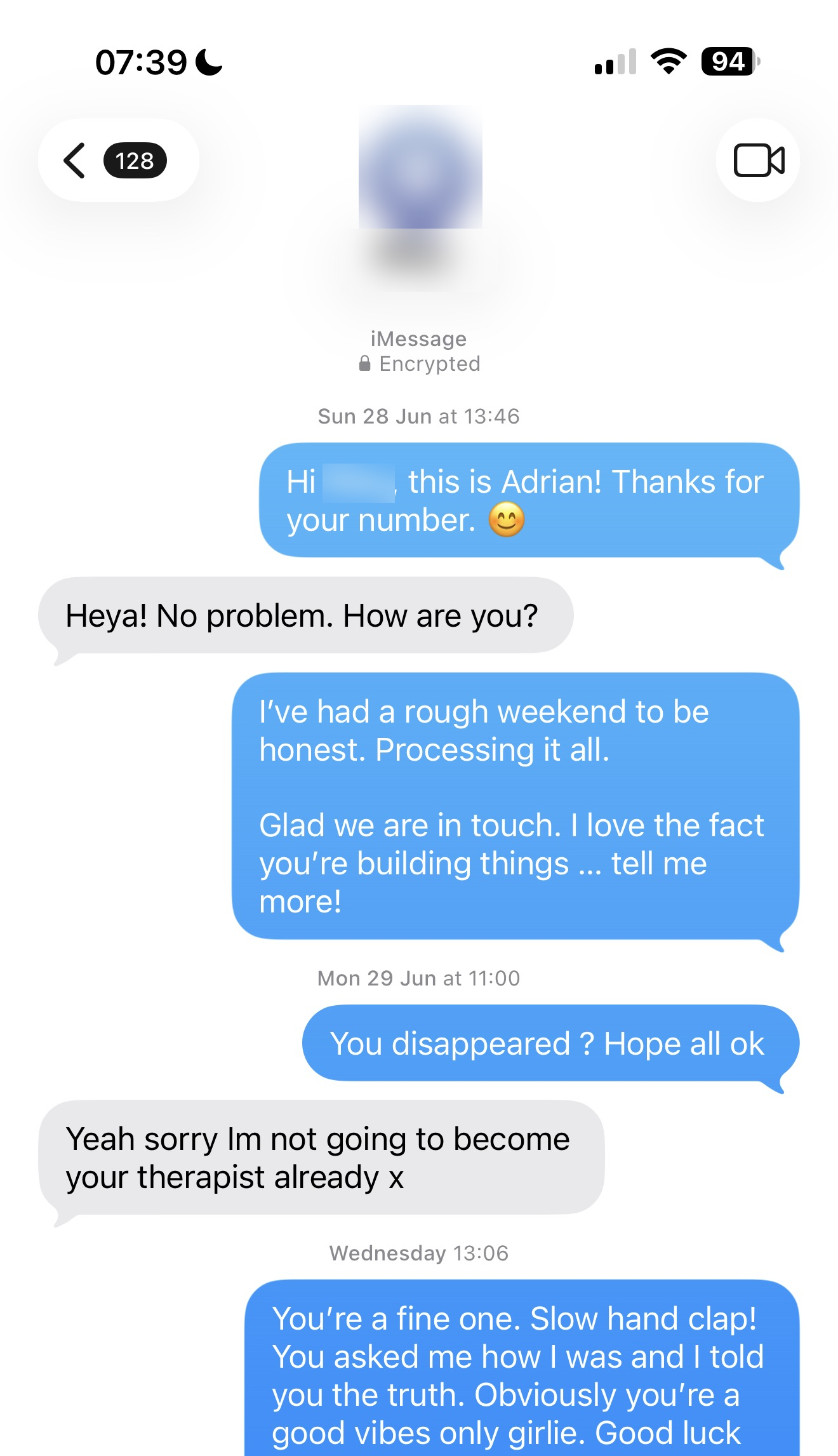
Her therapist line stung. And I sat with the sting for a day or so, and then I did what the trained gentleman does when the resentment finally runs out of storage: I lashed. Not a scene — I don't make scenes, I was raised far too well for scenes. Something worse in its own way. A message with a smile on its face and a knife in its pocket. You're a fine one. Slow hand clap. You asked me how I was and I told you the truth. Obviously you're a good vibes only girlie. Good luck.
Read the anatomy of that message, because I've had to. Sarcasm. A verdict on her whole character, rendered from two data points. A dismissal dressed as a send-off. What it wasn't, anywhere in it, was the true thing. The true thing was four words long: that actually hurt me. I answered honesty with honesty, got punished for it, and had a completely legitimate hurt to report — and I could not report it. I could perform contempt, but I could not say ouch.
That's the same wiring I've been writing about since the first of these pieces. The man who couldn't tell his wife the money was running out is the man who couldn't tell a stranger she'd stung him. Contempt is what hurt looks like when it's been trained never to introduce itself by name. The lash protected me from the one sentence that would have made me genuinely vulnerable — more vulnerable than the weekend confession ever did — because that hurt hands someone the confirmation that they got to you. And somewhere far down, the old arithmetic was running: a man who admits being hurt by a woman's flick of dismissal has failed at being a man twice over.
So look at the full circuit of what happened between two strangers in four days. She asked for emotional honesty in writing and flinched when it arrived. I preach emotional honesty for a living and, the moment it cost me something, swapped it for point-scoring. Her training beat her profile. My training beat my principles. Fifty-fifty, as ever. Two people running inherited code at each other, both losing to software neither of us installed.
What the mutuality would actually look like
I keep circling one word in all this, and the word is mutual.
Because the assumption buried in the spec sheet — hold my emotions, have none that need holding — is the same assumption I was raised inside, just photographed from the other side. I was trained to be the holder: the boy who managed his mother's moods, the husband who absorbed the stress so nobody else had to feel it. The profiles are, in effect, advertising for the man I spent fifty years being. And I can tell you from inside the costume: it isn't love. It's service. The man providing it is not present in the relationship; he's on duty in it. And the bill for all that unfelt feeling arrives eventually, made out to everyone in the house.
Real availability is a two-way door or it's nothing. It means I can hold your fear without flinching, and — this is the half the culture keeps dropping — you can hear mine without hearing a wall collapse. It means how are you is a real question in both directions, and not the easiest, to be honest is an acceptable answer from either mouth. Anything less isn't emotional intimacy. It's emotional room service, and the profiles asking for it are asking, sincerely and without knowing it, for the very cape they'd swear they want men to take off.
And here I want to own something plainly, because there's a version of her therapist line that points at true north. We are, I hope, at the dawn of something: men finally doing their own work. The wound-tending, the pattern-mining, the naming of what was handed to us. That labour is ours. It belongs in therapy, in men's groups, on the page, in rooms built for it, with people who signed up for it. I mean that concretely: I've recently qualified as a facilitator with Men's Circle. It isn't therapy and it isn't coaching. It's a room where men talk honestly about what we're facing, name the work each of us needs to do, and hold each other to account for actually doing it. Where we grow our self-awareness, look squarely at our impact on the people around us, and learn to hold space for one another without fixing, rescuing, or handing out advice. If you're a man reading this and any of it lands, there's a drop-in circle every Wednesday night. Come once. See what it's like to say a true thing in a room built to hold it.
For generations men outsourced the whole job to the women in their lives, handed the bag over at the door and called it marriage, and women's exhaustion with that arrangement is completely legitimate. A partner is not a therapist. She was right about that much, even if she fired it at a man who had asked for nothing yet.
So the deal, as I understand the new one, runs like this. My healing is my responsibility. I don't get to hand a woman my unprocessed childhood and call it intimacy; the destination, as I wrote in an earlier piece, belongs to the one doing the healing. And in return, a question crosses the table, and it deserves a straight answer: in an equal world, can you hold space for the emotions of the man in your life the way you very reasonably expect him to hold yours? Nobody is asking anyone to carry his wounds. The work stays his. The ask is smaller and harder: that one honest sentence from him lands as connection, the same as it would from her. Right now the equality conversation runs one way. It asks men to open up, and it rarely asks whether anyone is ready to receive the man who does. Both halves have to move. Men have further to travel — after generations under the cape, we would — and I concede that without a fight. But further is different from alone.
And men — before anyone gets comfortable — the mirror half is ours. We say we want to be met, held, allowed our own hard days. Then somebody stings us and out comes the slow hand clap, because contempt feels stronger than ouch. If we want the door open in both directions, we have to be able to walk through it ourselves when it costs something. One honest sentence when it's easy doesn't count. The sentence that counts is the one after the sting.
I don't know what happened on her side of the screen after my last message, and it isn't mine to narrate. Maybe nothing. Maybe a shrug, on to the next. Maybe, some evening, the small nagging sense of a gap between the profile she wrote and the moment she was tested on it. I hope it's the third, not because I need her to be wrong, but because that gap is where all of this actually changes — hers and mine both.
The question I'll leave with you
So here it is, from whichever side of the screen you're reading.
Think of the last time someone you wanted something from handed you one honest sentence — a fear, a rough weekend, a that hurt. Not a flood. One sentence.
What did you do with it?
Because the profile is easy. The vocabulary is easy. Every one of us, me included, is emotionally available right up until availability presents its first invoice. The real answer isn't in what any of us are seeking. It's in what we did, last time, in the ten seconds after somebody told us the truth.

Adrian Melrose Newsletter
Join the newsletter to receive the latest updates in your inbox.