The Prosecutor Rises
Part two. On blame, the courtroom in the chest, and a Saturday morning phone call from a driveway I used to call mine
Two weeks ago, on a Saturday morning, my phone rang. My younger daughter, nineteen, distraught, calling from the driveway of our family home. She had been edging the car out, a driveway I know intimately and have never trusted, on her way to collect someone from the airport. A cyclist came down the hill from her right, met the front edge of the car, went over his handlebars, and was badly hurt.
I was in London. The driveway is a hundred miles away. I stayed calm on the call, and I'm glad of that; she needed a steady voice and she got one. The police came, the ambulance came, and a man was taken to hospital with injuries I would not wish on anyone, and whose recovery matters more than anything else in this story.
It was after the call that the courtroom filled.
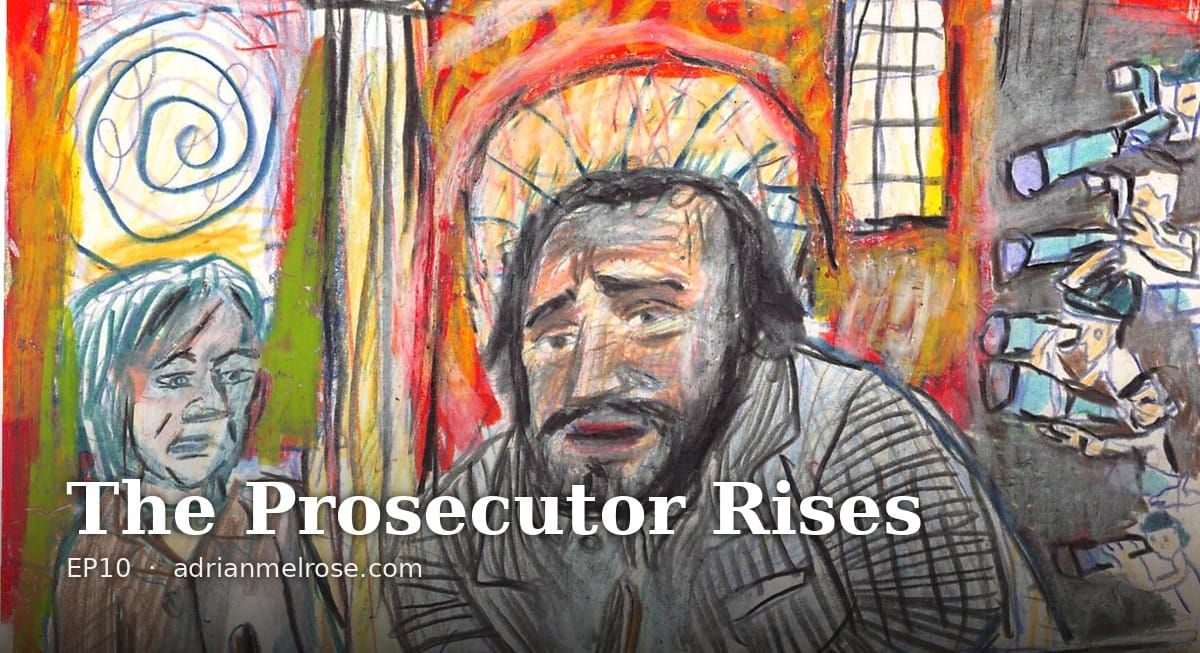
I have never felt the machinery I wrote about in the last essay run so nakedly, or in so many directions at once. Within the hour, the prosecutor in my chest was up and pacing, and he had three cases open on the desk.
The first was against my family. Why was my nineteen-year-old expected to be the family taxi, an airport run of nearly three hours there and back? I used to do those runs. That was my job, the family concierge, the man who drove so nobody else had to. And underneath the anger, doing all the actual work, was the thought the anger was protecting me from: she was in that driveway because I wasn't. That's not a fact, by the way. It's a sentence the prosecutor wrote. But it had my full attention.
The second case was about the mirrors. Across the lane from that driveway there are convex mirrors, there to show what's coming down the hill from the right and around the corner from the left. They were dirty and part-hidden by foliage, and I knew it, because four days before the accident my daughter had mentioned it and I'd told her to get them cleaned. The reply came back with a teenager's precision: don't poke your nose into business that's no longer yours, Dad.
And the prosecutor didn't just have a brief there. He had a history. Because those mirrors had been on my list for years, back when the house was mine to run. People worked at that property, drove out of that driveway daily, looked into those same clouded mirrors to do it, and the mirrors still didn't get cleaned unless I put them on the to-do list. In the early years I did it pleasantly. By year five I was doing it bitterly, telling myself the sentence that became the anthem of that chapter of my life: nothing gets done here unless I do it. I've written before about the ledger nobody sees, the invisible work of keeping a household from fraying, and how carrying it alone hollowed me out. The mirrors were one line in that ledger. By the time I left the family house I was exhausted in a way I couldn't name yet, and the exhaustion had curdled into a resentment I mostly swallowed, which is to say it went into the ledger too.
So when the mirrors, of all things, turned out to be dirty on the morning a cyclist came down that hill, the prosecutor stood up holding five years of receipts. See? You always said it. Nothing gets done unless you do it. And now look. It's an intoxicating case, because parts of it are true. The resentment was real. The lack of initiative was real, or real enough. But watch what the case is actually for: it converts an accident into a vindication. It offers me the chance to be right about the worst morning of my daughter's year. That's the stick again, one-up even in catastrophe, and I'm ashamed of how good it felt for the ninety seconds I let it run.
Which opened the third case, the real one, the one the other two existed to obscure: the case against me. Because if the mirrors were no longer my business, it was because I'd left. The divorce sat under the whole morning like a floor under furniture. If I still lived there, said the prosecutor, I'd have kept the mirrors on the list the way I always had. If I still lived there, I'd have been the one edging out of that driveway. The charge sheet wasn't really about mirrors or airport runs at all. It read: you left, and this is the bill.
None of those three cases was true in the way the prosecutor claimed. All of them were doing the same job: converting a morning of helpless fear into something with a defendant, because a defendant is easier to live with than the truth, which was that my daughter was frightened and hurt a man without meaning to, a man was in hospital, and I was a hundred miles away with nothing to do but feel it.
And there's a coda that shames me more than any of it. My eldest daughter took over the airport run while the police were still with her sister. When I reached her in the car, the anger finally broke the surface, at her, of all people, the one person actively helping: why on earth are you driving to the airport, you should be with your sister. It landed on her as an attack, and I understand why, because whatever I meant, an attack is what came out of the holster. There's a whole other essay in that call and the repair it needed, and I'll write it. For now it belongs here as evidence: when the courtroom fills, the prosecutor doesn't check who's in the dock. He just needs someone in it.
If you read the last essay, you know where this machinery was built. I was trained young onto what Terry Real calls the measuring stick, shame at one end, grandiosity at the other, by a mother who medicated my wounds with you're better than them and a country that had written the same sentence into law. And I said that judgment, the stick's daily work, runs in two speeds. That essay was about the slow one: the standing habit, the accents and the rankings and the maintenance payments. This one is about the fast speed. What the stick does when something breaks.
Because blame is judgment in a hurry.
The machinery
Blame doesn't run in the background the way judgment does; it arrives, fast, on the heels of pain. Something awful happens, something is lost or broken or taken, and before the feeling has even finished landing, the question is already out of the holster: whose fault is this? Who can I be angry at? Where does this get filed? I've now shown you my own Saturday-morning version. Let me take the machinery apart.
I've come to think of blame as the mind's refusal of grief. Pain with a culprit is easier to carry than pain on its own, because a culprit gives you something to do. Grief just asks to be felt, and feeling was never the family strong suit. So the machinery converts hurt into a case: evidence, verdict, sentencing. It's the same stick, the same courtroom, just running at emergency speed. Judgment asks who is worth less? at leisure. Blame asks it at the scene of an accident.
And the culture I live in has industrialised the move. We are a legalistic civilisation: liability, negligence, whose insurance, who signed what, who can be held to account. Some of that is necessary; contracts and consequences are how adults organise themselves. But somewhere along the way the legal reflex became the emotional one. Something terrible happens and the first public question is never what needs tending? It's who do we destroy? Watch any bad news break and you can see an entire society doing what I do: refusing the grief, reaching for the file.
I'm living inside that machinery right now: the police and the insurers are doing their careful, necessary work on the question of fault, and it hangs over the family while it's done. Their version of the question is legitimate; it's their job. What I've had to learn is that their question and mine are different instruments. Theirs will settle liability. Mine was never going to settle anything. It was just the stick, asking who is worth less at the scene of an accident.
And I'll admit the pull of one more position, because I felt it that morning. There's a version of me that could have set up home in the wronged chair: the father far away, cut out of the decisions, no longer consulted about mirrors. Aggrieved and blameless at once. It's a seductive seat, because it's the one place in the courtroom where my own conduct never comes up. I sat in it for a while that Saturday. Then I remembered who was actually standing in the driveway.
And now the part I have to say in the present tense, because pretending this is all past would be one more performance of better-than. When something goes wrong, I still reach for blame. Still. It comes up like bile, that fast, that physical, that little to do with thinking. Someone cancels, something breaks, a phone rings on a Saturday morning, and I can feel the prosecutor rising to his feet before I've even understood what I've lost. Fifty years of training doesn't dissolve because you've written some essays about it.
What's changed is what happens next. I'm getting better at noticing the bile as bile, at catching the rising and naming it: that's the old machinery, that's not information about who's at fault, that's information about me. I don't always bite my tongue in the moment; my eldest daughter can testify to that. But I'm getting better at that too, and I've stopped demanding a clean record from myself, because demanding a clean record is just the stick again, pointed inward. The work isn't to never feel blame rising. The work is the gap, the half-second between the bile and the sentence, and the gap is trainable.
The most useful thing I've learned to do in that gap is ask one question: what do I actually need right now? Because underneath nearly every reach for blame, I find an unmet need wearing a lawyer's clothes. I don't need a culprit; I need reassurance, or rest, or to be listened to, or to grieve the plan that just died. On that Saturday I needed none of the things the prosecutor was offering. I needed to know my daughter was safe. I needed news of the man in the hospital. I needed to mourn, honestly, the fact that I wasn't there, without converting the mourning into a verdict on anyone. Blame is what the need looks like after the courtroom gets hold of it. Separate the two, and the case usually collapses on its own, because there was never a defendant. There was just a man who needed something and had only ever been taught prosecution as the way to ask.
Peter Crone hands me the sentence that dissolves the whole docket, and I reach for it more than any other tool I own: what happened happened, and it couldn't have happened any other way, because it didn't. Read it fast and it sounds like fatalism. It isn't. It's the end of the argument with reality. The accident happened. The mirrors were dirty. I wasn't there. No verdict, against the family, against the mirror-keepers, against myself, changes a single fact of that morning, and every hour spent in the courtroom is an hour not spent asking the only live question: what do I actually need now, and what does my daughter need from me? What happened happened. The case was always with reality, and reality doesn't settle.
Before I leave the courtroom, one honest note about where blame does its most patient damage. It isn't strangers. It's partnership: the shared decisions that go wrong, and the sentences that follow. It was your idea. I never wanted this. You did. I know those sentences from both sides of a marriage, in my mouth and in my ear, and they deserve more than a paragraph in passing, because they attack the very thing a partnership is. That essay is next. For now it's enough to say that the prosecutor doesn't stay in your chest. Given a house, he moves in.
The melting
I wish I could tell you I reasoned my way off the stick. It would make a better story about me. The truth is that the first real loosening came from somewhere I didn't expect, and I want to be careful about how I tell it, because the temptation is to make it the hero of the piece, and it isn't.
A few years ago I began microdosing psilocybin for a period of three months. I'm not going to argue anyone toward that choice; it was mine, made carefully, and this is a report, and by no means a prescription. What I noticed, over weeks, was something I can only describe as a steady dose of compassion arriving from underneath the thinking. Not an insight. A feeling: that I was connected to the people around me, all of them, the ones I'd have placed above me and the ones I'd have placed below. The stick didn't break. It just became, for stretches at a time, absurd. You cannot rank people you feel continuous with. It would be like the left hand claiming seniority over the right.
And in those stretches I got to experience, for the first time I can consciously remember, what the factory setting feels like. We are all born the same way: small, helpless, and completely lovable, with nothing yet achieved and nothing yet owned. Every ranking that comes later is construction. I had known that as an idea for years; I'd have nodded at it in any seminar. Feeling it is a different order of knowledge. The judgment didn't have to be argued down. It melted, the way ice melts, because the conditions that maintained it were gone.
But here's the part that matters more than the chemistry: what melted first toward others, melted next toward me. That's the arithmetic of the stick running in reverse. If placing people is how worth works, the judge can never leave the courtroom; and if placing people stops making sense, the trial of the self loses its jurisdiction too. I found I was speaking to myself differently. Less prosecution, more curiosity. The permanent session I'd been running since childhood started adjourning early, then some days not convening at all. The medicine didn't do that. The medicine opened a door, and compassion walked through it, and compassion turned out to be the thing my mother was reaching for on all those afternoons, the real antidote she didn't have in the cabinet. Not you're better than them. Something closer to: you were never in the competition, my boy. Nobody is.
I want to say that plainly for her sake, because the last essay held her responsible for a training, and responsibility without compassion is just blame with references. She medicated me with grandiosity because grandiosity was what she'd been given for her own pain, by her own people, in her own time and country. The parcel came to her sealed, the way it came to me sealed. She passed it on out of love, at a kitchen table, to a boy who was bleeding. I've stopped asking her, even in memory, to have had medicine she was never issued. That, too, is the melting.
The work that's left
I'd love to end there, rewired and finished. But I've stopped writing endings like that, because they're one more bid to be better than, better than my past self, better than the reader still mid-struggle, and the whole essay collapses if I close it from the top end of the stick.
So here's the honest present tense. The blame still comes up like bile. The prosecutor still rises, and two weeks ago he rose with three cases in hand while my daughter stood shaking in a driveway. What's different is that I notice him now, most days, somewhere between the rising and the speaking, and in that gap I've learned to ask what I actually need. Sometimes I find the need and say it, plainly, the way I once knocked on a door about a snooze alarm. Sometimes I bite my tongue too late, prosecute for a sentence or two, and have to go back and repair; there's a phone call with my eldest daughter that taught me that all over again. The gap is trainable. It is not yet reliable. Both of those are true, and I've made my peace with working in the space between them.
Because the aim was never a self that doesn't judge. The aim is a self that catches it, owns it, and reaches for the need underneath before the courtroom fills. Compassion isn't a place you arrive. It's a practice with a relapse rate, and the practice is the point.
So let me leave you where these essays always leave you, with the question turning outward.
You have a prosecutor too. You'll know him by his speed: the verdict that arrives before the feeling has finished landing, the bile that rises before the grief. He'll have a case ready the next time something breaks, and parts of it will even be true. That's what makes him convincing.
When he next rises, and he will, what would happen if, just once, you let the case collapse, and asked instead what you actually need?

Adrian Melrose Newsletter
Join the newsletter to receive the latest updates in your inbox.