What I Couldn't Name
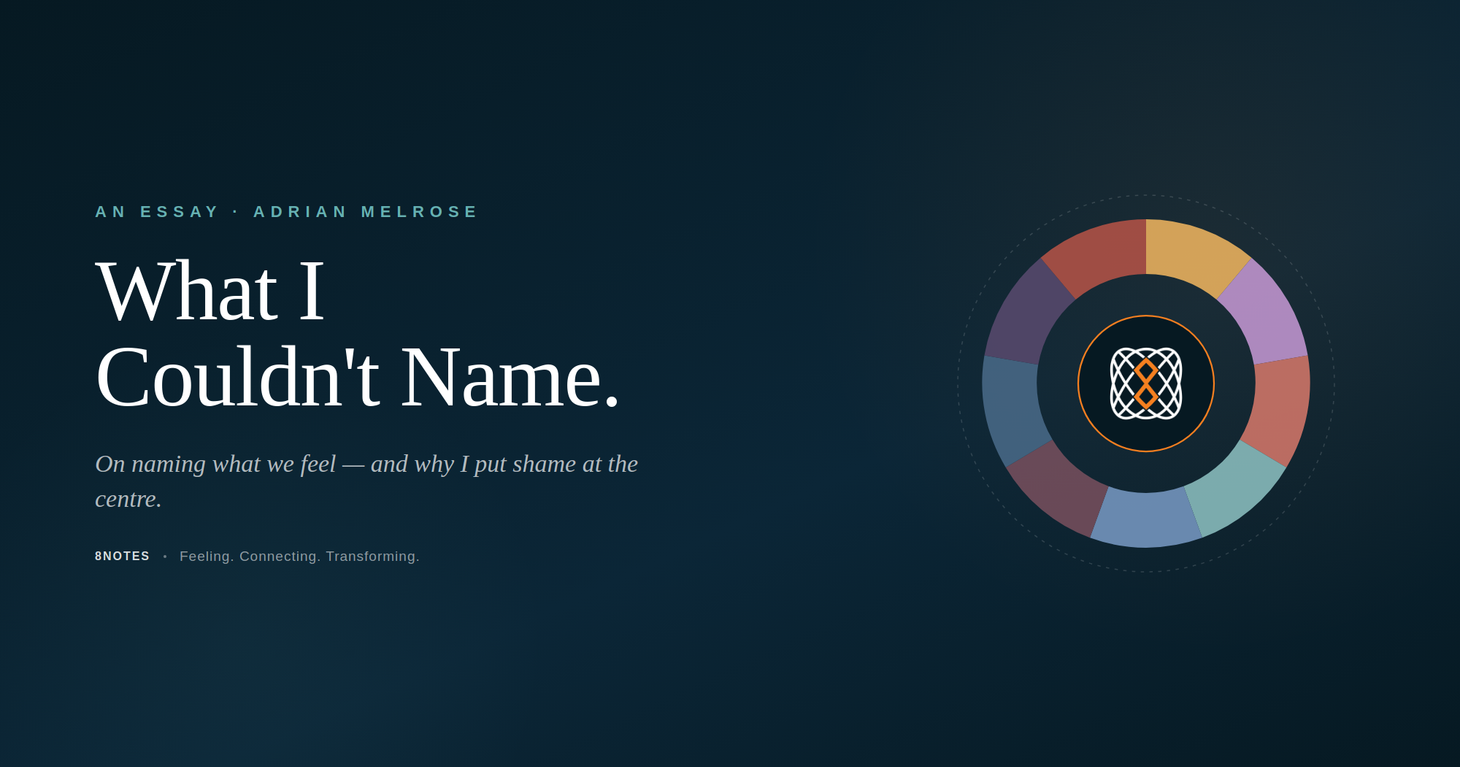
You can't be intimate with what you can't name. This is a piece about why I built a feelings wheel — and why I put shame at the centre of it.
This post comes in two parts. The first is the story. The second is the theory behind it — the thinkers, the structure, the bones. Read either, or both. Your call.
I. The story
The first time someone put a feelings wheel into my hand, I panicked.
They pointed at the laminated circle and asked, gently, "Which one of these are you in?"
I looked at the wheel. I looked at them. I looked at the wheel again.
A wheel full of words for what could be happening inside me. A wheel full of shades. A wheel full of possibilities.
And I had, all through my life, just had three.
Happy. Sad. Angry.
And — this is the part that took me longest to understand — I couldn't use them at the same time. I thought feelings were like settings on a dial. You were in one. You moved to the next. You picked the one that fit.
That isn't how it works. That isn't how any of this works.
You can stand on the Sea Point promenade on a perfect Cape Town morning, holding the visceral, knee-buckling beauty of the place — and at the same time hold something heavier, slower, more honest: the legacy of apartheid, the inequality you can see from where you're standing, the children who were never going to be allowed near this view. You can be in awe and in grief in the same breath. You can love your father and be furious with him in the same conversation. You can feel pride in your child and a bone-deep loneliness about how fast they're growing up. You can be safe and afraid. Held and alone. Excited and dreading it.
Feelings are not settings on a dial. They are chords. Three notes, six notes, sometimes more — sounding at the same time, in the same body.
I didn't know that. I had three drawers. I went looking for the one that was closest. I closed the others.
If you had asked me, in that moment, what I was actually feeling — what was stirring in my chest, what my jaw was holding, what was happening to my breath — I couldn't have told you. Not because I wasn't feeling anything. I was full of something. I just had no idea what to call it.
So I picked one at random. Probably frustrated. It felt close to angry. Angry was familiar.
We moved on. And I sat there for the rest of that conversation knowing — without being able to articulate it — that I had just lied. Not to them. To both of us. I had named something that wasn't the thing, because I had no word for the thing.
Here is what I've come to understand, after two years of doing the work properly — mostly with Dr Sarah Madigan, to whom I owe almost all of this:
My body always knew.
It had been telling me, in tightness and looseness, in heat and coolness, in shallow breath and deep, in clenched hands and open palms, for forty years. I just hadn't been listening. Or rather — I had been listening, but only to the three loudest frequencies. Everything else got picked up as noise.
What I lacked wasn't sensitivity. It was a palette. Words to name what my body was already showing me.
And here is the thing I didn't grasp for the longest time: the labelling was already happening. The body knew. The unconscious mind knew, too — it had already labelled what was happening, already sorted it, already decided what it meant and how to respond. The labelling had been done all along. What hadn't happened was bringing any of it into consciousness.
So the autopilot ran me. The response my nervous system had been running since I was eight ran me. Not because something was wrong with me, but because the unconscious is fast and defended, and nobody had ever shown me how to slow it down.
That is the silent crisis of the men I work with: not that we don't feel, but that we have so few conscious words for what we feel that the feelings themselves stay underground — where they leak out as anger, as numbness, as the third drink, as the affair, as the cold remark at the dinner table, as the small cruelty to a child we love.
Brené Brown's research finding is one of the most important sentences I know: people who can name what they feel can do something with it. Those of us who can't, can't.
So I built a wheel.
And I put shame at the centre of it. Here's why.
Most feelings wheels in circulation today — and there are a lot of them; this territory is well-trodden — leave shame out, or hide it under "fear," or fold it into sadness. I think that's wrong.
Shame is its own continent. It is the meta-emotion. It is the emotion about the self. It is the voice that whispers "you are not enough; if they really knew you, they would leave." It is the engine of the third drink. It is the architecture of the affair. It is the unseen structure of the way most of the men I know are living, alone inside their own skin.
I put shame back at the centre of this wheel — as one of nine cores, not a flavour of fear — because in the men's work I do, shame is the single most important territory we have to map.
Most of the loneliness epidemic among men is, in my view, downstream of shame. We do not feel ourselves to be lovable, so we cannot risk being seen. We cannot risk being seen, so we cannot be known. We cannot be known, so we are alone. We compensate with grandiosity, or with withdrawal, or with the workshop in the garden where no one bothers us. We tell ourselves we are fine. We tell ourselves we are independent. We are not independent. We are isolated, and the cost of that isolation is showing up in our marriages, our friendships, our children, our bodies, our suicide statistics.
The way out is not to fix the shame. It is to name it. To sit with it. To get curious about it. To find a friend — or a coach, or a therapist, or a circle of other men — who will sit with you while you do.
That is all this wheel is trying to be. A way to start naming.
There's a Feelings Wheel — for the times when you want to see the whole map at once. Nine emotions. Fifty-four families of conscious feeling. The chords that live where notes meet. And, around the outer edge, the five flavours of disconnection — the place most of us go when feeling itself becomes too much.
And there's a Feelings Wizard — a slower, gentler door. For the days when the wheel is too much, when nothing is coming through, when the body is loud but the mind is quiet. The wizard asks one question at a time, and lets you narrow down. It also has a door called the quieter door — for the moments when "I don't know what I'm feeling" is the most honest thing you can say. That, too, is information.
Both tools live at wheel.8notes.co.uk. They are free. They will always be free.
A wheel is a map, not the territory. The point is not to find the right word and then file it away. The point is to find the word, let it point you back to your body, and stay there. The body is the territory. The wheel is just a finger pointing at the moon.
II. Behind the wheel
What follows is the architecture — the thinkers I borrowed from, the theory under the wheel. Part I stands on its own; this is for anyone who wants to look under the hood.
The body's signals
Start with the neuroscience, because that's the floor.
Antonio Damasio — through his work with patients who had specific kinds of brain damage — showed that emotion and reason are not opposites. They are partners. His somatic marker hypothesis holds that the body sends signals (a chest tightening, a stomach drop, a small flush of heat) which are processed pre-consciously, and which tag every option you are considering with an emotional valence. The body helps you decide before the mind has caught up. If those somatic markers aren't getting through to consciousness, you cannot make a good decision. You can only make a defended one.
This is the technical difference between emotion and feeling. Emotion is the body's pre-verbal response. Feeling is the conscious naming of it. You can have an emotion without a feeling. Most of us do, most of the time. The body knows; the conscious mind hasn't caught up.
Fast labels and slow labels
The labelling that happens automatically — the labelling Part I points to, the labelling the unconscious is doing all the time — is what Daniel Kahneman called System 1. Fast. Intuitive. Built from a lifetime of pattern-matching. Cheap to run.
The labelling that happens deliberately, on purpose, with curiosity, is System 2. Slow. Effortful. Examined.
Most of life runs on System 1, and most of the time that is a feature: you don't want to deliberate about every breath. But when you're trying to understand your own emotional life, System 1 is exactly wrong. It is making the calls before you've even seen the territory. It is labelling what's happening now with labels you built when you were eight years old, alone in your bedroom, trying to figure out what was safe.
The work of a feelings wheel is, in this sense, to slow you down enough to engage System 2 — to look at the label your unconscious has slapped on, and ask if it is still the right one.
The parts inside
There is a third frame I lean on, from Richard Schwartz's Internal Family Systems work. IFS sees the psyche as composed of parts — a kind of internal cast.
One part is the eight-year-old who learned to keep his head down when his father came home angry. Another is the protector who keeps that eight-year-old away from anyone who reminds him of his father. Another is the manager who keeps everything calm at work, no matter the cost. None of these parts are you. They are parts of you. They have served you. They also sometimes run you. The work is to know them. To see them. To thank them. To let them rest when they don't need to be in charge anymore.
This is what Terry Real — whose Relational Life Therapy I am currently training in — calls the adaptive child. The version of you that figured out, somewhere around age six or seven or eight, how to survive whatever family you were born into. He learned to be small. Or charming. Or invisible. Or the achiever. Or the joker. His adaptation was brilliant — it kept you alive. It just isn't who you are anymore. And his hyper-vigilant labelling of every emotional situation, which made sense when you were eight, mostly doesn't now.
I deliberately left this unnamed in Part I — "the response your nervous system has been running since you were eight" — because anyone who knows attachment theory or Real's work will hear it without being told, and anyone who doesn't would have been slowed down by the jargon. Here, it has a name. It's the adaptive child.
The wheel's lineage
The wheel itself stands on four pairs of shoulders.
Brené Brown is my north star. Her Atlas of the Heart maps eighty-seven distinct emotions and human experiences. But more important than the number is the invitation: to be curious about what's happening inside you, to sit with it long enough to find the right word, to know that the right word changes the texture of the thing. Curiosity is the only door. You cannot bludgeon a feeling into clarity. You can only get interested in what your body is trying to say.
Marshall Rosenberg — the father of Nonviolent Communication — taught me that feelings are signals about needs. Every emotion is information. Anger tells you that something matters. Sadness tells you that you have lost something. Loneliness tells you that you need to be known. The work is not to fix the feeling or make it go away. The work is to read it like a compass.
Terry Real — already named above for the adaptive child — also gave me the grandiose / shame axis. The one-up and one-down moves that men make all day long to avoid the one thing we cannot bear: the experience of being small, flawed, not-enough. He gave me language for what most men I know are doing for most of their lives: hiding.
Robert Plutchik — whose original wheel I have been redrawing — gave me the geometry. The idea that emotions are not a list but a map. That they have relationships. That joy sits across from sadness for a reason. That what we call love is a combination — what Plutchik called a dyad — and you cannot really understand what love is unless you understand its constituent notes. We're not picking single notes. We're hearing chords.
Thank you
To Dr Sarah Madigan — drsarahmadigan.com — without whom none of this would exist. Two years of patient, exact, fearless work has built the floor I am now standing on. If you want the inner work done properly, by someone who actually understands trauma, attachment, and the body — go to her. I cannot recommend her highly enough.
To Damasio, Kahneman, Schwartz, Brown, Rosenberg, Real, Plutchik, and the generations of teachers whose shoulders this stands on.
And to the men (and obviously also women) in the circles I run — who keep showing up, week after week, trying to find the words for what they feel.
It is the bravest thing you can do.
— Adrian

Adrian Melrose Newsletter
Join the newsletter to receive the latest updates in your inbox.